
The Evidence-First MVP: Build What the Market Pulls
Most MVPs fail from weak evidence, not bad code. Use observable demand to shape hypotheses, scope, and success criteria before you build.
1) Why most MVPs fail: weak evidence, not weak engineering
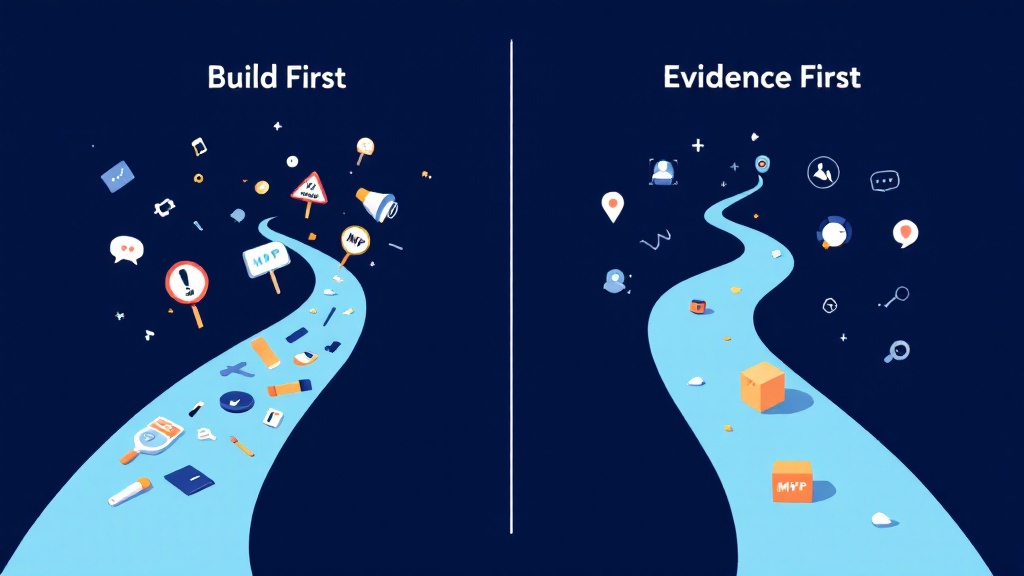
An MVP isn’t “the smallest thing you can code.” It’s the smallest product that can validate a specific promise with real users. Many startup ideas die because founders treat building as discovery: they pick a concept, ship features, and then hope the market responds. That’s a product-strategy anti-pattern—velocity without direction—where burn grows faster than learning.
An evidence-first MVP starts earlier, with market-validation signals you can observe: repeated complaints in forums, high-intent search queries, crowded competitors with obvious gaps, and workflows people already pay to patch with spreadsheets or manual labor. The goal is not certainty; it’s enough evidence to form testable hypotheses: who the ICP is, what job they’re trying to get done, and what measurable outcome they’ll pay for.
This founder-playbook mindset reframes MVP scope: you’re not building “an app,” you’re testing a value proposition under constraints. When you anchor your mvp to evidence, you create faster iteration loops—and you avoid shipping something polished that nobody pulls.
2) The evidence-first workflow: from signals to hypotheses to crisp MVP scope
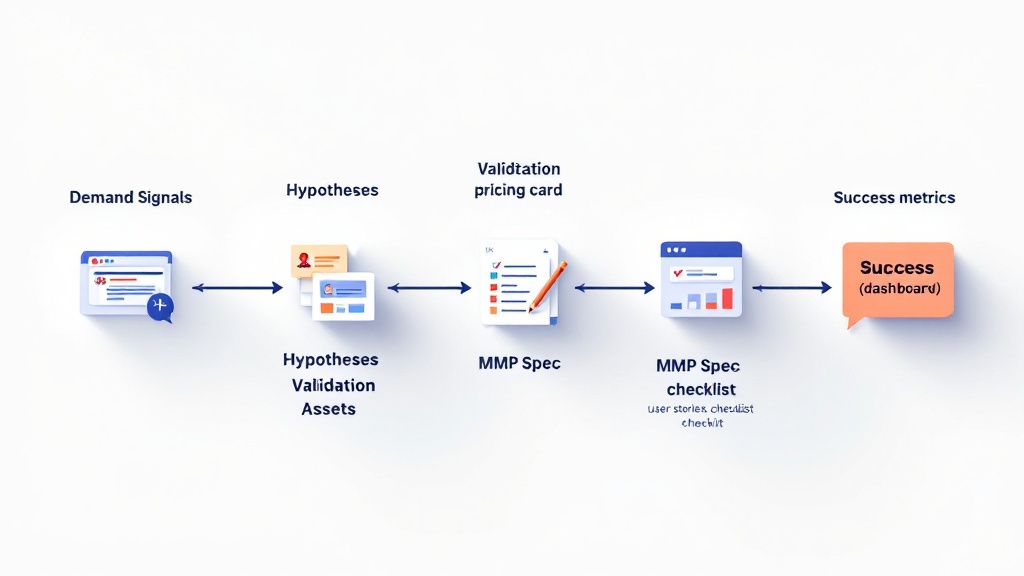
Start by collecting demand signals for your startup-ideas: search intent (“how to reduce dentist no-shows”), recurring posts (“patients forget appointments”), and buyer language (“we lose thousands monthly”). Then translate signals into a narrow hypothesis: For [ICP], [problem] happens because [cause], and we can improve [metric] by [mechanism]. This gives you something falsifiable, not just a vibe.
Next, define the validation assets before code: positioning, a one-page landing test, and a simple pricing experiment. Your goal is to measure behavior—email signups, demo requests, preorders—not compliments. From those results, draft a specification that prevents scope creep: user stories tied to the hypothesis, the smallest workflow that delivers the promised outcome, and explicit non-goals.
Finally, set success criteria that match the stage. An mvp might “win” with 10 qualified leads and 3 pilots, or with a retention signal like “weekly active usage by office managers.” This product-strategy discipline turns market-validation into engineering clarity, so your build work compounds instead of resets.
3) Make it repeatable: ship faster by connecting validation to production delivery

The hard part isn’t knowing the steps—it’s coordinating them across disconnected tools. Founders often validate in docs, spec in tickets, build in a repo, deploy somewhere else, then manually stitch together analytics, payments, and go-to-market. The result is slow iteration: by the time the MVP ships, the learning window has moved.
An orchestrated workflow (like IdeaToShip AI) treats validation and shipping as one continuous system. Observable demand informs the plan; the plan becomes structured artifacts (ICP, positioning, landing copy, user stories); and those artifacts drive codegen, checks, and DevOps automation—repo setup, environments, cloud provisioning, and repeatable releases. Integrations matter here: GitHub for source, hosting for deployment, analytics for measurement, payments for willingness-to-pay, and GTM outputs (email + social) to generate trials.
The payoff is an evidence-first founder-playbook you can run repeatedly: each iteration tightens scope, improves metrics, and reduces wasted build time. Build what the market pulls, measure it, and let the data decide what you ship next.